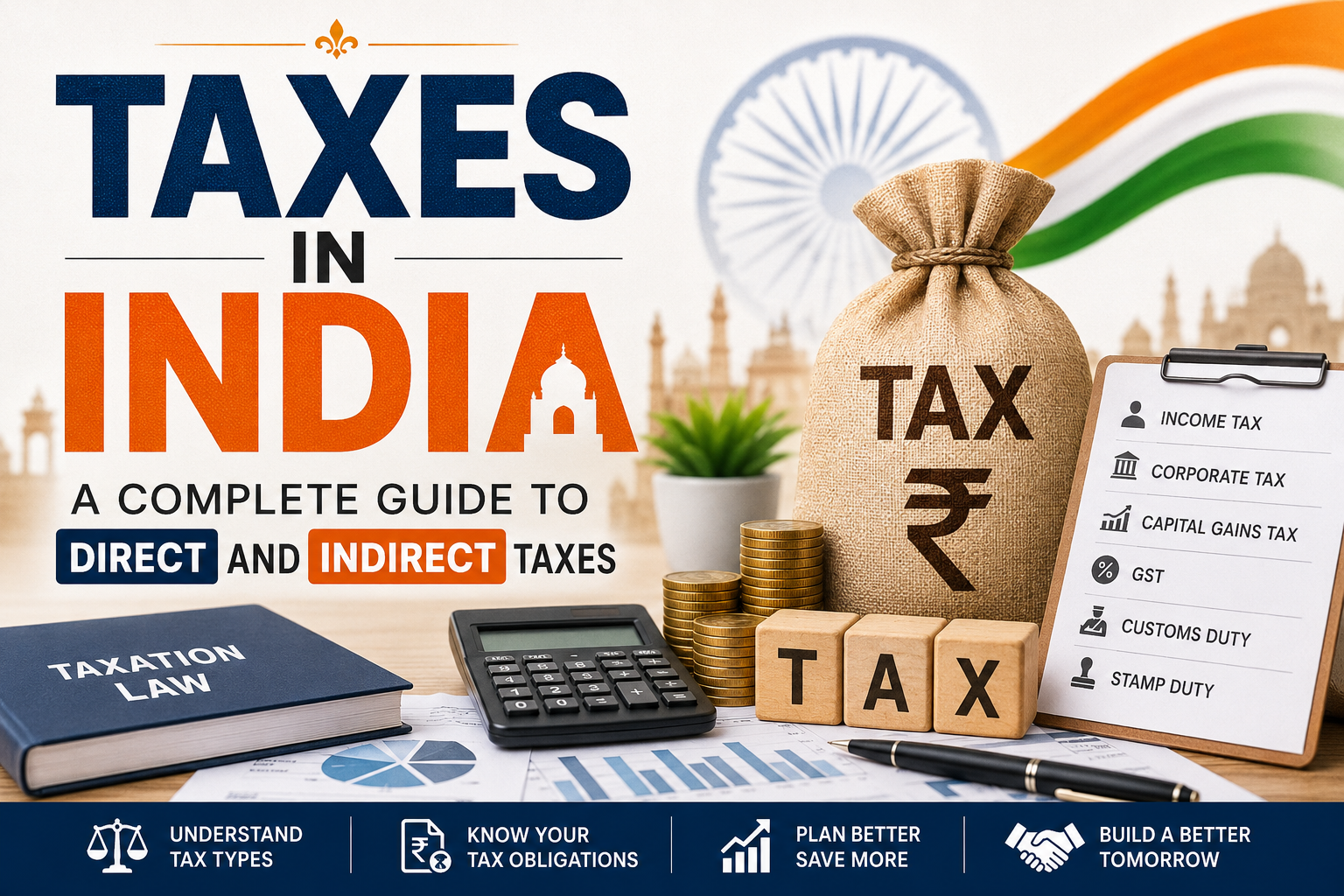
Taxes are an essential part of every country’s economy. They provide the government with the funds needed to build infrastructure, improve healthcare, support education, strengthen national security, and deliver public services. In India, taxes are broadly classified into Direct Taxes and Indirect Taxes, each serving a different purpose.
Whether you’re a salaried employee, business owner, freelancer, or simply curious about India’s taxation system, understanding the basics of taxes can help you stay compliant and make better financial decisions.
What is Tax?
A tax is a mandatory financial charge imposed by the government on individuals, businesses, and organizations. The revenue collected through taxes is used to fund public welfare and developmental activities across the country.
Every eligible taxpayer is legally required to pay taxes according to the applicable laws.
Types of Taxes in India
The Indian taxation system is divided into two major categories:
- Direct Taxes
- Indirect Taxes
Let’s understand each in detail.
1. Direct Taxes
Direct taxes are taxes paid directly by the individual or organization to the government. The burden of these taxes cannot be transferred to another person.
Examples of Direct Taxes
Income Tax
Income Tax is one of the most common direct taxes in India. It is levied on the income earned by individuals, Hindu Undivided Families (HUFs), firms, companies, and other entities.
Sources of taxable income include:
- Salary
- Business or profession
- House property
- Capital gains
- Other sources such as interest and dividends
The amount of tax payable depends on the applicable tax slab and the chosen tax regime.
Corporate Tax
Corporate Tax is imposed on the profits earned by companies operating in India. Domestic and foreign companies are taxed under different provisions of the Income Tax Act.
Capital Gains Tax
Capital Gains Tax is charged when a capital asset such as property, shares, or mutual funds is sold for a profit.
Capital gains are generally classified as:
- Short-Term Capital Gains (STCG)
- Long-Term Capital Gains (LTCG)
The applicable tax rate depends on the type of asset and the holding period.
Securities Transaction Tax (STT)
STT is levied on the purchase and sale of securities traded on recognized stock exchanges in India.
2. Indirect Taxes
Indirect taxes are collected by sellers or service providers from consumers and deposited with the government. The tax burden is ultimately borne by the end consumer.
Goods and Services Tax (GST)
GST is India’s unified indirect tax system introduced in 2017. It replaced multiple indirect taxes such as:
- VAT
- Service Tax
- Excise Duty
- Entry Tax
- Luxury Tax
- Entertainment Tax (except where retained by local authorities)
GST is charged on the supply of goods and services across India.
Types of GST
CGST (Central GST)
Collected by the Central Government on intra-state transactions.
SGST (State GST)
Collected by the respective State Government on intra-state transactions.
IGST (Integrated GST)
Collected on inter-state transactions and imports.
UTGST (Union Territory GST)
Applicable in Union Territories without a legislature.
Other Important Taxes in India
Although many taxes have been merged into GST, several other taxes and duties continue to exist.
Stamp Duty
Stamp Duty is charged on legal documents, especially during the purchase or transfer of immovable property.
Property Tax
Property Tax is collected by municipal authorities from property owners to maintain civic infrastructure and local services.
Professional Tax
Some state governments levy Professional Tax on salaried employees and professionals. The rules and rates vary from state to state.
Customs Duty
Customs Duty is imposed on goods imported into or exported from India to regulate international trade and protect domestic industries.
Road Tax
Road Tax is paid at the time of vehicle registration and is governed by individual state governments.
Why Do We Pay Taxes?
Taxes play a vital role in the development of a nation. The government uses tax revenue for:
- Building roads and highways
- Public healthcare services
- Education and schools
- National defense
- Railways and transportation
- Welfare schemes
- Digital infrastructure
- Law enforcement
- Disaster relief
- Rural development
- asdfghjkl
Paying taxes contributes directly to the country’s economic growth.
Benefits of Paying Taxes
Legal Compliance
Timely payment of taxes helps individuals and businesses remain compliant with the law and avoid penalties.
Nation Building
Taxes fund essential public infrastructure and social welfare programs.
Better Creditworthiness
Income Tax Returns (ITRs) are often required when applying for:
- Home loans
- Personal loans
- Business loans
- Credit cards
- Visa applications
Business Growth
Registered businesses can claim eligible deductions, input tax credits under GST, and establish greater credibility with customers and financial institutions.
Tax Planning Tips
You can legally reduce your tax burden through proper tax planning.
Some useful practices include:
- Invest in eligible tax-saving instruments.
- Keep accurate records of income and expenses.
- File Income Tax Returns before the due date.
- Maintain proper invoices and documentation.
- Claim eligible deductions and exemptions.
- Consult a qualified tax professional for complex financial situations.
Remember, tax planning is legal, while tax evasion is illegal.
Common Mistakes Taxpayers Should Avoid
- Missing tax filing deadlines
- Not reporting all sources of income
- Claiming incorrect deductions
- Ignoring GST compliance for businesses
- Failing to maintain financial records
- Not verifying Income Tax Returns after filing
Avoiding these mistakes can save you from penalties, interest, and legal complications.
Conclusion
The Indian taxation system is designed to generate revenue for national development while ensuring fairness across different categories of taxpayers. Understanding the difference between direct and indirect taxes helps individuals and businesses make informed financial decisions and remain compliant with tax laws.
Whether you are a salaried employee, entrepreneur, freelancer, or business owner, staying updated with tax regulations and filing your taxes on time is an important financial responsibility. Proper tax planning not only helps you save money legally but also contributes to the growth and development of India.
By understanding how taxes work, you can better manage your finances, avoid penalties, and fulfill your responsibilities as a responsible citizen.